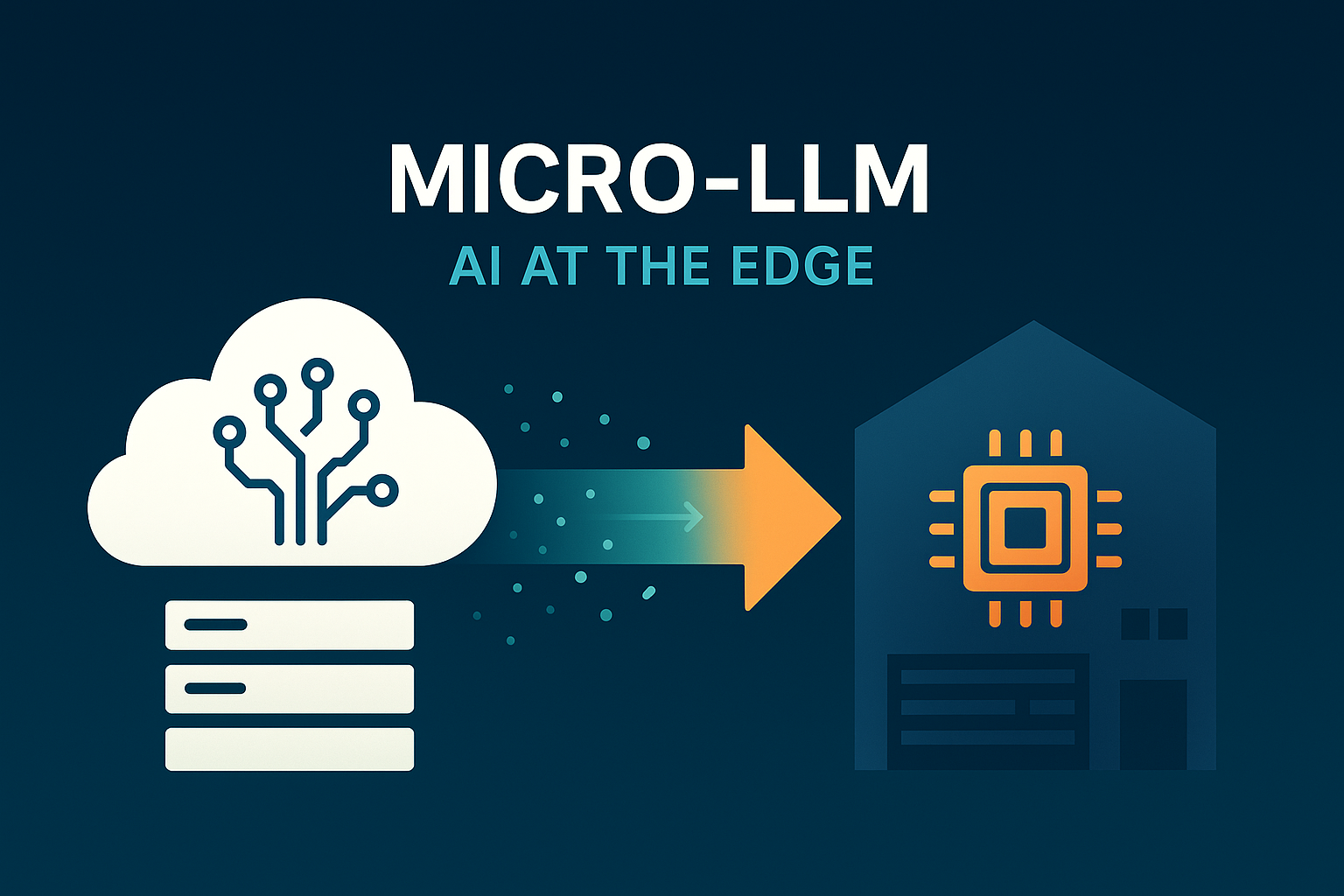
This trend is not about settling for less performance; it's about optimizing for utility, cost, and security. Micro-LLMs—typically models with 1 to 10 billion parameters—are engineered to deliver highly specialized AI capabilities directly within existing business infrastructures.
Understanding the Strategic Rationale
The move toward smaller, specialized models addresses three critical challenges that have made deploying general-purpose Large Language Models (LLMs) difficult for many enterprises:
1. The Cost of Inference at Scale
Running inference on a massive model (100B+ parameters) is incredibly compute-intensive and expensive when processing millions of requests daily. Micro-LLMs dramatically reduce the operational burn rate. By running a smaller, highly optimized model, companies can achieve comparable task-specific performance while shrinking inference costs by factors of 10 or more. This makes high-volume, real-time AI applications, like immediate customer service responses or dynamic content tagging, finally economically viable.
2. Data Sovereignty and Security
In regulated industries (finance, healthcare, defense), sending proprietary or sensitive data to a third-party, general-purpose cloud API is often prohibited. The Micro-LLM trend enables on-premise deployment, or even deployment on the edge hardware itself. When the model runs entirely within the company’s firewall, proprietary data never leaves the controlled environment, ensuring data sovereignty and compliance with strict regulatory frameworks.
3. Precision Through Specialization
A smaller model that has been intensively fine-tuned on a company’s narrow, unique data corpus (e.g., specific engineering manuals, legal contracts, or trade documentation) often exhibits superior performance on those specific tasks compared to a larger model trained on generalized public internet data. This is achieved through techniques like Parameter-Efficient Fine-Tuning (PEFT), which effectively molds the smaller model into a highly specialized expert in the organization’s domain.
Key Technical Enablers of the Shift
The Micro-LLM movement is powered by advancements in model optimization and hardware acceleration:
- Quantization: This process reduces the model's memory footprint and speeds up inference by representing the model's weights using lower-precision integers (e.g., 4-bit or 8-bit) instead of standard 16-bit floating-point numbers. This is critical for edge deployment.
- Knowledge Distillation: A technique where the knowledge and abilities of a large, high-performing "teacher" model are transferred to a smaller "student" model. This allows the smaller model to inherit complex capabilities while maintaining its compact size.
- Optimized Hardware: The increasing availability of consumer-grade GPUs and specialized AI accelerator chips optimized for efficient low-precision inference has made it possible to deploy powerful Micro-LLMs on smaller, dedicated server racks rather than requiring massive data centers.
The Emerging Enterprise Standard
Three months ago, the conversation pivoted from "Can we use an LLM?" to "How small and secure can we make this LLM?" Micro-LLMs are quickly solidifying their position as the preferred approach for operational, high-value enterprise AI, offering a sustainable balance of performance, security, and cost-efficiency.